Contact Info
- 6th Floor, I & M Building 2nd Ngong Avenue, Upper Hill
- +254 (0)20 2985000; +254 (0)729 111031 / +254 (0)731 000065
- info@pasgr.org
- Office Hrs: Today 9.00am to 6.00pm
Follow us


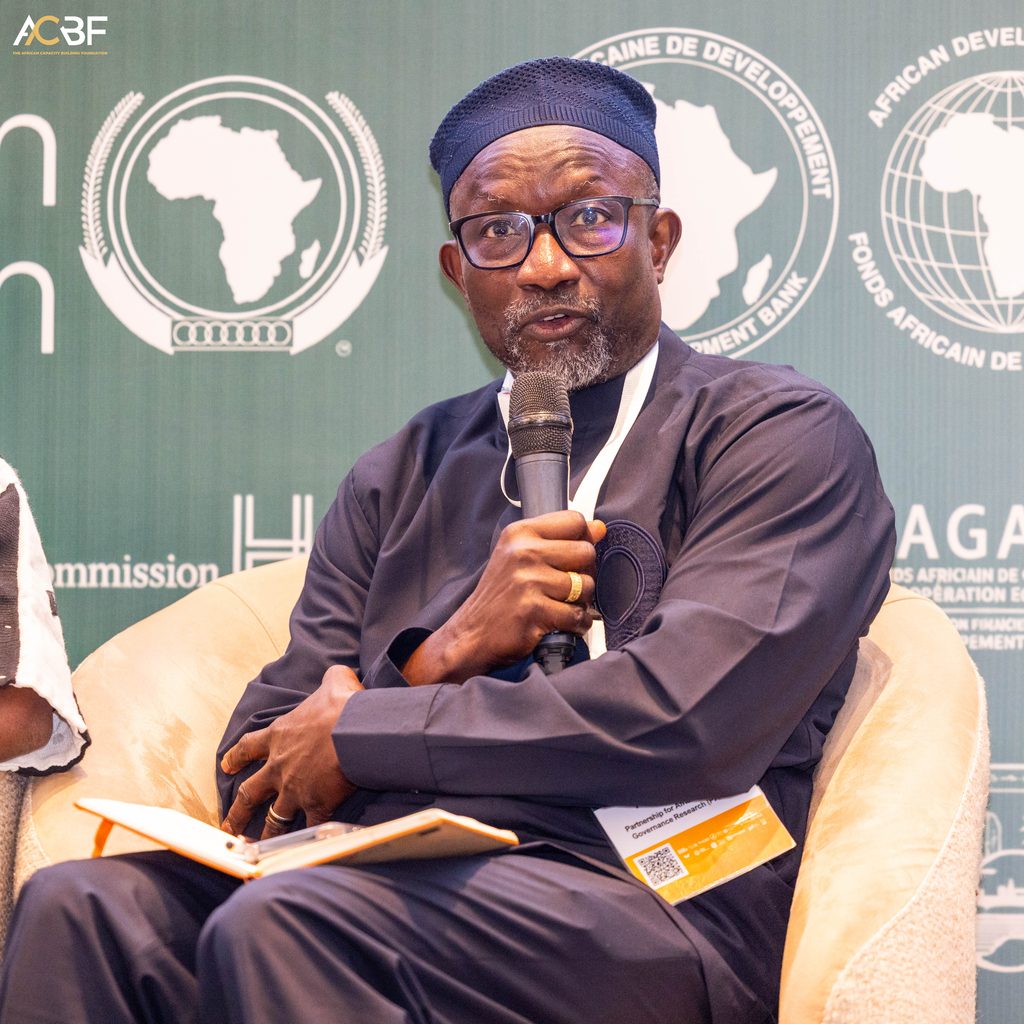
For Africa’s energy transformation, counting connections is only part of the story. The next challenge is to turn research into policies that deliver reliable, affordable electricity and to track whether those policies produce results.
That was the message from PASGR Executive Director, Prof. Fadel Ndiame, at the 12th Africa Think Tank Summit, held in Cotonou, Benin, from October 28–30, 2026. Representing think tanks in a closing-day plenary dialogue, he called for greater collaboration among African research institutions and a stronger focus on implementation.
Convened by the African Capacity Building Foundation (ACBF), in collaboration with the Government of the Republic of Benin and the African Union, the Summit brought together some 300 policymakers, researchers, private investors and development partners from more than 50 countries.
Its theme, “From Energy Access to Economic Transformation: Practical Policy Pathways for Power Sector Viability, Growth, and Reform in Africa,” framed a practical question: how can reliable and affordable energy become a stronger driver of industrialisation, competitiveness and inclusive growth?
Discussions focused on improving utility performance, strengthening policy and regulatory environments, and attracting investment, moving beyond broad commitments towards reforms that countries can implement.
On October 30, Prof. Ndiame joined the plenary session, “Commitment Dialogue: Five Seats, One Ask: Youth, Consumers, Financiers, Think Tanks and Policymakers Commit to Africa’s Energy Transformation.”
The dialogue brought together constituencies that had participated in separate discussions over the three days, asking each to identify what it would contribute, who would take responsibility and when it would deliver. The session was designed to bring those commitments into a joint statement ahead of the closing ceremony.
Alongside Prof. Ndiame were Mariama Mamane, Founder of Jacigreen, representing youth and entrepreneurs; Dr Rafael Latham-Proença, Associate Program Officer at Coefficient Giving, representing financiers and funders; Dr Emmanuel Sogadji, Executive Director of the African Consumers Organization, representing consumers; and Pamla Gopaul, Unit Lead for Economic Analysis and Foresight and Head of the Africa Policy Bridge Tank at AUDA-NEPAD, representing policymakers.
Speaking on behalf of think tanks, Prof. Ndiame emphasised that producing evidence must be accompanied by deliberate efforts to translate it into impactful policies. He urged institutions to collaborate rather than compete for resources, highlighting the potential of pooled funding, aligned conceptual approaches and shared data collection tools to strengthen stakeholder engagement and policy influence.
His contribution placed collective delivery at the centre of the think tank role: working together to generate useful evidence, engage decisionmakers and refine the systems needed to support Africa’s growth.
On behalf of the constituency, he committed to developing metrics that go beyond counting energy connections, alongside tracking matrices to monitor the implementation of power and energy initiatives by ATTS 2027. The commitment linked research production with a further responsibility: reporting back on progress.
During the Summit week, Prof. Ndiame also participated in a separate virtual public lecture honouring Prof. Omotade (Tade) Akin Aina, who served as PASGR’s Executive Director from 2014 to 2020.
Held on October 28 under the theme “The Role of Philanthropy in Higher Education in Africa,” the lecture featured Prof. Funmi Olonisakin of King’s College London as guest lecturer and Prof. J. K. Olupona of Harvard University as chair. It provided a platform to reflect on philanthropic partnerships that support stronger institutions, academic freedom, equity, innovation and locally grounded knowledge production.
In PASGR’s goodwill message, Prof. Ndiame recognised Prof. Aina’s role in consolidating the organisation’s foundations and institutionalising its flagship initiatives, including the Master of Research and Public Policy Programme across 13 universities in seven African countries.
“Most notably, Professor Tade championed the conceptualization of the evidence–policy nexus,” Prof. Ndiame noted in the tribute. “This breakthrough paved the way for our Utafiti Sera framework, a well-tested innovation that now defines how we generate knowledge and drive policy uptake, earning recognition far beyond the African continent.”
The message also recognised Prof. Aina’s contribution to researcher development, resource mobilisation and mentorship, alongside his continuing service on PASGR’s Board.
“He was an extraordinary mentor who truly believed that leadership existed within everyone,” Prof. Ndiame said in the tribute.
The Summit closed on October 30 with the adoption of the Cotonou Communiqué, bringing the discussions into a shared set of priorities for power-sector reform and implementation.
The communiqué identified six priorities: stronger institutions; improved utility governance; expanded regional electricity trade; stronger project preparation and contract negotiation capacity; greater productive use of energy; and a stronger voice for women, consumers and young people in reform processes.
These priorities placed the quality of electricity service alongside the expansion of access. Connections carry greater economic value when households and businesses can depend on affordable, reliable power for daily life and productive activity.
ACBF Executive Secretary Mr. Mamadou Biteye emphasized the importance of research that speaks directly to policy and implementation, supported by stronger institutional capacity. Prof. Kevin Chika Urama of the African Development Bank left participants with two questions that captured the Summit’s practical focus: What did we learn, and what will we now do differently?
For PASGR, the commitment towards ATTS 2027 provides a concrete point of follow-through: helping think tanks demonstrate not only what evidence they produce, but how that evidence supports implementation and measurable progress.



Leave A Comment